Showing posts with label ~c:photo. Show all posts
Showing posts with label ~c:photo. Show all posts
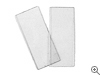
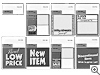
Discontinued
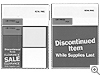
Discontinued
n. An ITEM that will no longer be sold once on-hand supplies are depleted.NOTE: Discontinued ITEMS are easy to identify. Their SHELF TAG clearly says “Discontinued.” OK. So, now what?
Occasionally, you'll be standing in the AISLE holding a CASE of something for which you can't find a HOLE on the SHELF. You've looked hard, but it's really not there. So, you may wonder: is it NEW, or is it Discontinued?
Don't guess. Always ask the GROCERY MANAGER, if present. At his instruction (only), you may receive permission to “DISC.” it, as above. However, you can't ever Discontinue an ITEM yourself, just because you can't find it! The alternatives are to MARK the CASE either “New” or “N.O.S.”—but which?
The answer is, only write “New” on the un-found ITEM'S CASE if you know for sure it's a NEW ITEM. Otherwise, if there's even the slightest doubt, you should write “N.O.S.” for NOT-ON-SHELF.
No more thinking required! Both N.O.S. and NEW designations go into exactly the same place: the NEW ITEMS RACK in the BACK ROOM. Down the road, someone else (e.g., the GROCERY MANAGER) will eventually sort out what should be done with them.
HOW TO: Handle Discontinued ITEMS
- Fill the SHELF, same as always, anytime you encounter a Discontinued ITEM. The only difference is what you do with the leftovers...
- Any left?
- Put a large “DISC.” (for Discontinued”) on the CASE with your MARKER, and circle it to draw attention to the CASE NOTATION.
- Drop it off in RECEIVING on the designated SHELF in the RACK back by the GATE. If there's not enough space, leave it on the floor nearby.
Occasionally, you'll be standing in the AISLE holding a CASE of something for which you can't find a HOLE on the SHELF. You've looked hard, but it's really not there. So, you may wonder: is it NEW, or is it Discontinued?
Don't guess. Always ask the GROCERY MANAGER, if present. At his instruction (only), you may receive permission to “DISC.” it, as above. However, you can't ever Discontinue an ITEM yourself, just because you can't find it! The alternatives are to MARK the CASE either “New” or “N.O.S.”—but which?
The answer is, only write “New” on the un-found ITEM'S CASE if you know for sure it's a NEW ITEM. Otherwise, if there's even the slightest doubt, you should write “N.O.S.” for NOT-ON-SHELF.
No more thinking required! Both N.O.S. and NEW designations go into exactly the same place: the NEW ITEMS RACK in the BACK ROOM. Down the road, someone else (e.g., the GROCERY MANAGER) will eventually sort out what should be done with them.
 0
Comments
• Keywords:
~~D,
~c:graphic,
~c:note,
~c:photo,
~c:steps,
~d:single,
~i:n.,
~r:changed,
BACK ROOM,
EXPLANATIONS,
HOW-TO,
RECEIVING,
SIGNAGE,
TAGS,
THE SHELF,
THROWING
0
Comments
• Keywords:
~~D,
~c:graphic,
~c:note,
~c:photo,
~c:steps,
~d:single,
~i:n.,
~r:changed,
BACK ROOM,
EXPLANATIONS,
HOW-TO,
RECEIVING,
SIGNAGE,
TAGS,
THE SHELF,
THROWING
Discount Rack
Discount Rack
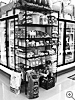
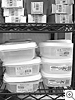
n. A special RACK set aside for CUSTOMERS to inspect potential bargains on ITEMS that have been DISCONTINUED, may have sustained slight damage, are the final remaining leftovers from an IN-AN-OUT SHIPPER, etc. See also DISCOUNT TAG, below.NOTE: In my STORE, the Discount Rack is located at the front end of the Dairy/Frozen DEPARTMENT, in what would be AISLE NUMBER 16, except it has no posted number.
Discounted ITEMS are MARKED DOWN by the RECEIVER, who applies a special DISCOUNT TAG over the ITEM'S regular UPC.
Discounted ITEMS are MARKED DOWN by the RECEIVER, who applies a special DISCOUNT TAG over the ITEM'S regular UPC.
TIP: Price Check, Mate? Occasionally you may be paged by a cashier to do a PRICE CHECK on an ITEM the REGISTER reports as ITEM-NOT-FOUND. That's your cue to look first on the Discount Rack for a similar item, as maybe the DISCOUNT TAG came off of the ITEM you're being asked to check. Don't find a mate to the one you're holding? Check the SHELF. Still no luck? Ask the GROCERY MANAGER, if available. Otherwise turn it back over to the CSM or FRONT-END MANAGER to resolve the issue. As a STOCK CLERK, you don't set PRICES.
Discount TAG
Discount TAG
n. 1. A special yellow TAG that overlays a PRODUCT'S usual UPC code, so that the special DISCOUNT PRICE rings up at the CHECKOUT REGISTERS. Typically used for ITEMS on the MARK DOWN RACK. 2. A SHELF TAG that shows a reduced PRICE because the ITEM is ON SALE, DISCONTINUED, etc. See also DANGLER.
0
Comments
• Keywords:
~{T,
~~D,
~c:graphic,
~c:photo,
~d:multi,
~d:single,
~i:n.,
~r:changed,
~r:update,
SIGNAGE,
TAGS,
THE SHELF
Door Seal
Door Seal
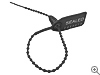
n. A small, single-use, serial-numbered plastic tag with one-way, one-time loop fastener used to “secure” two eye-bolts or hasps, such as on a door and a door frame, and thus provide evidence as to whether or not the door, hatch, gate or other such access point has or has not been opened.NOTE: Door seals answer the question, “Did this (door, hatch, whatever) open during the time it was supposed to stay closed?” Door Seals are very easily broken, and virtually impossible to repair. The point is not to provide a barrier, but to provide proof that the door or whatever has remained closed, and thereby support the function of the LOCK and ALARM. ALARMS can be disarmed, and LOCKS can be opened, but like Humpty Dumpty, Door Seals can't be put back together again. Likewise, when it's time to be legitimately broken, its serial number has to match the one previously written down in the M.O.D.'s log book, or else you know there's been foul play.
0
Comments
• Keywords:
~~D,
~c:graphic,
~c:note,
~c:photo,
~d:single,
~i:n.,
~r:new,
~r:update,
BACK ROOM,
EXPLANATIONS,
MATERIALS,
RECEIVING,
SECURITY
Dummy Box
Dummy Box
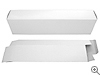
n. A long CARDBOARD BOX, usually plain white, that is used to reduce the amount of INVENTORY that fits on the SHELF, and thereby save the STORE money. See also INVENTORY, MOVE, TURNOVER.NOTE: The basic idea here is to use an inexpensive “filler” to change the CASE MODULUS of the HOLE. Cutting down the number of CASES or additional partial CASES needed to fill it results in less LOAD standing idle. That's good, because the STORE doesn't make any money when ITEMS sit. Profit comes only when they sell. Doubtless some bright light somewhere has figured out a more optimal balance between the labor cost of filling a shallower SHELF more frequently vs. other factors, and hence Dummy Boxes are definitely here to stay.
They are RECEIVED as a SUPPLY in as a shrink-wrapped stack of flat cutouts. When assembled by folding, each one forms a rectangular prism that is used as a filler or spacer in the back of a SHELF'S HOLE to make it shallower.
Multiple Dummy Boxes may be STACKED vertically to provide a more even back-wall surface, and/or horizontally to further reduce the depth of the HOLE. Whether or not they're STACKED vertically often depends on the size, shape and/or weight of the ITEM that goes in that particular SPOT. Sometimes—especially on the top SHELF—they may be intentionally not STACKED vertically, in order to provide a buffer area for stashing a slight excess of one, two, or a few extras. Be careful, though. They're not capable of supporting much weight, so pilling on pickle jars is a no-no.
They are RECEIVED as a SUPPLY in as a shrink-wrapped stack of flat cutouts. When assembled by folding, each one forms a rectangular prism that is used as a filler or spacer in the back of a SHELF'S HOLE to make it shallower.
Multiple Dummy Boxes may be STACKED vertically to provide a more even back-wall surface, and/or horizontally to further reduce the depth of the HOLE. Whether or not they're STACKED vertically often depends on the size, shape and/or weight of the ITEM that goes in that particular SPOT. Sometimes—especially on the top SHELF—they may be intentionally not STACKED vertically, in order to provide a buffer area for stashing a slight excess of one, two, or a few extras. Be careful, though. They're not capable of supporting much weight, so pilling on pickle jars is a no-no.
TRUE STORY: If you're new, you might be tempted to remove one of these things the first time you find one. I did. Then it was explained to me: they're supposed to be there. Talk about feeling like a dummy!
0
Comments
• Keywords:
~~D,
~c:graphic,
~c:note,
~c:photo,
~c:story,
~d:single,
~i:n.,
~r:new,
~r:update,
EXPLANATIONS,
HOW-TO,
MATERIALS,
THE SHELF,
THEORY
Subscribe to:
Posts (Atom)
 = Hover to color, click to enlarge.